Breaking the long-signal barrier in gravitational-wave inference
Paper: Fast Bayesian Inference for Long-Duration Gravitational-Wave Signals in 3G detectors
arXiv:2609.05375
Binary neutron-star signals can remain in third-generation gravitational-wave detectors for hours. This creates a difficulty that is absent, or much less important, for the shorter signals usually analysed with current detectors: the Earth rotates appreciably while the signal is in band.
The detector antenna response therefore changes during the observation. Treating it as constant is no longer adequate.
The useful observation is that this time dependence is highly structured. For a ground-based interferometer in the long-wavelength approximation, the response can be decomposed into five sidereal harmonics,
\[ F(t) = \sum_{n=-2}^{2} F_n e^{i n\Omega_\oplus t}. \]
This is essentially the Jaranowski-Królak-Schutz decomposition of the rotating detector response. The five terms arise from the fact that the detector tensor is a symmetric trace-free rank-two tensor and therefore transforms in the five-dimensional (l=2) representation of rotations.
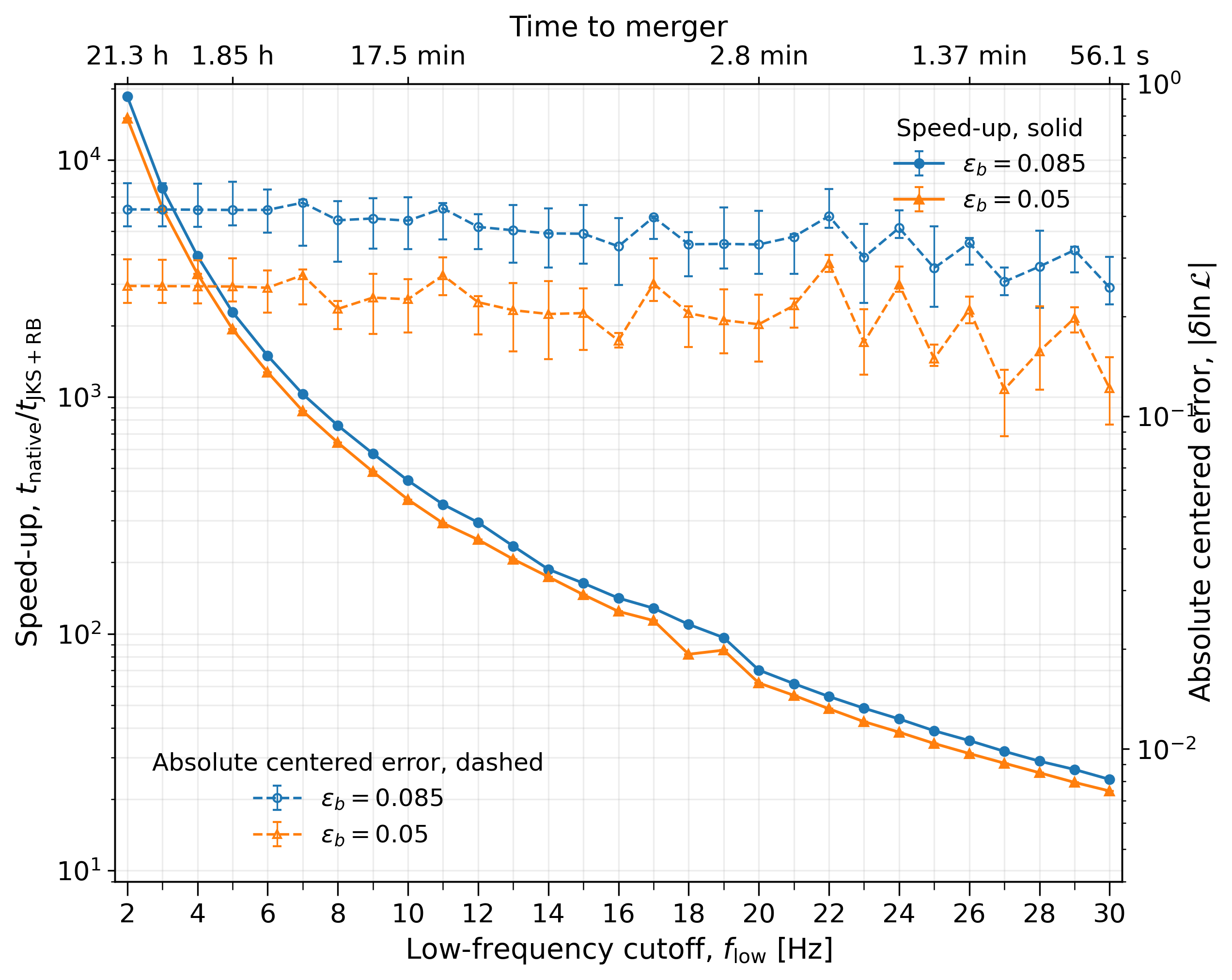
This decomposition is useful computationally because the slow sidereal modulation can be separated from the rapidly varying intrinsic waveform. The likelihood can then be evaluated using a small number of precomputed frequency-domain objects rather than repeatedly constructing the full time-dependent detector response.
In our implementation, this structure is combined with an adaptive frequency representation and error-controlled relative binning. The resulting likelihood remains accurate while substantially reducing the cost of evaluating long binary-neutron-star signals.
The broader point is that the duration of third-generation signals need not be treated only as a computational burden. The Earth’s rotation introduces additional structure into the data, and that structure can itself be used to accelerate inference and improve localization.